

App Description
A mid-sized biomedical research lab focused on immuno-oncology needed to improve the speed and consistency of its immune cell profiling workflows. The lab routinely processed large sample volumes (e.g., PBMCs from clinical cohorts) and faced bottlenecks with traditional flow cytometers that relied on hydrodynamic focusing.
- Overview
- Project:Attune NxT Flow Cytometer
- Platform:Desktop
- Role:UX Designer (New Feature Update)
- Audience:Lab technicians, academic researchers, scientists
- Safe :This project is presented in a portfolio-safe, external-facing format.
Case Study - New Feature
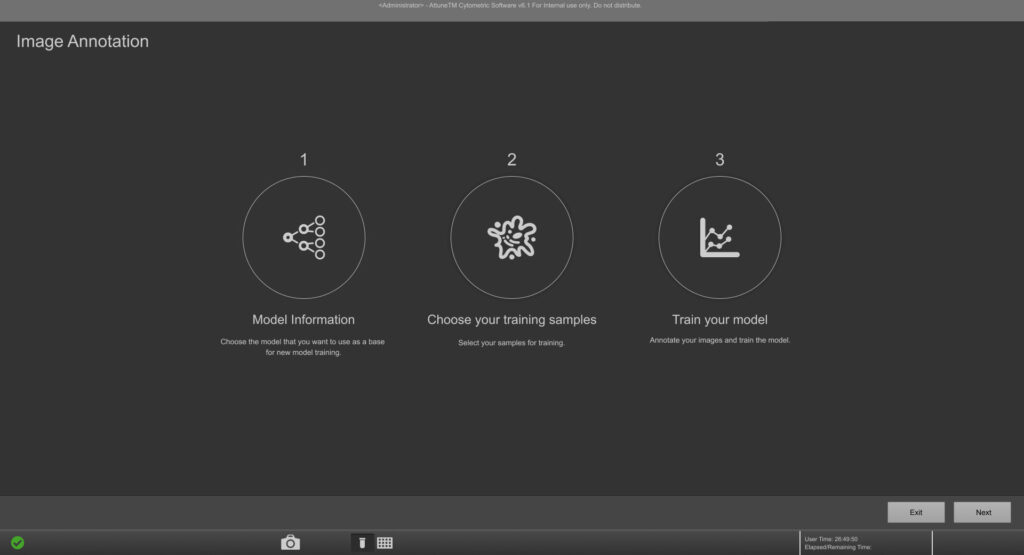
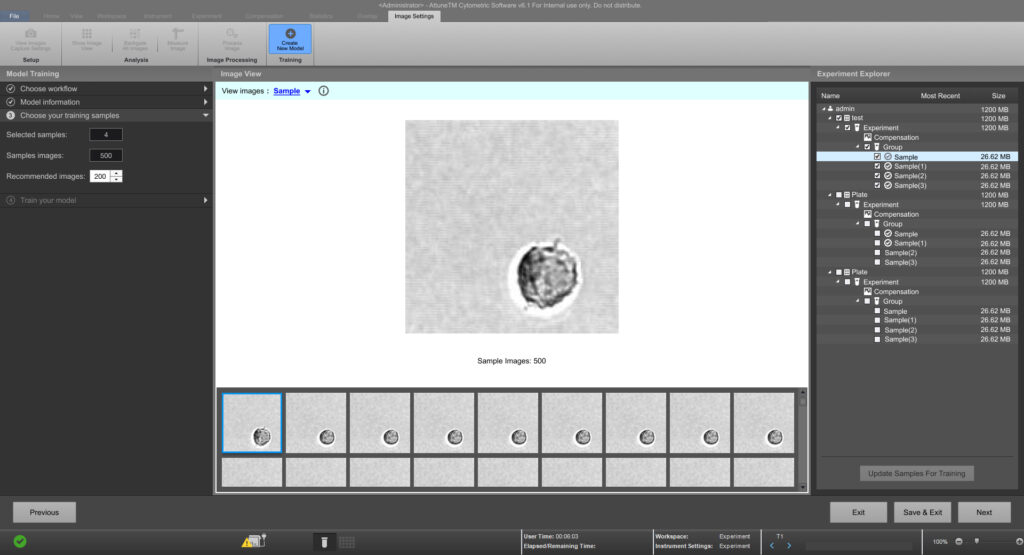
A research lab using the Attune™ NxT Cytometric Software (v6.1) aimed to automate cell detection and counting from brightfield images. Manual annotation was time-consuming and inconsistent, especially when dealing with large datasets (~500 images per sample).
The Challenge
- Manual cell identification introduced user bias
- Difficulty in consistently marking cell centers vs boundaries
- Large datasets slowed down annotation workflows
- Need for repeatable AI model training
The Solution
- Implemented Attune™ NxT image annotation workflow with centroid-based (“Hooke A”) approach
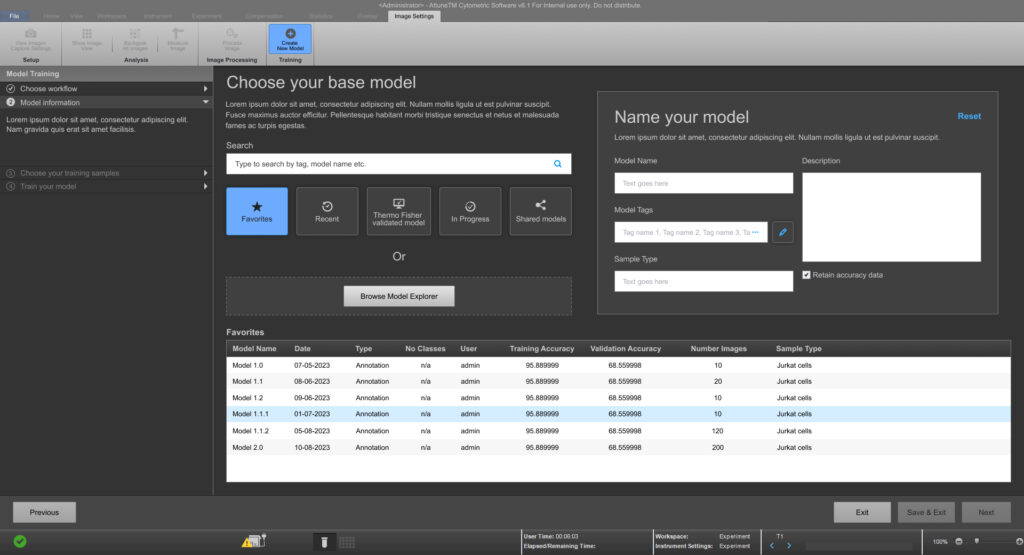
- Enabled rapid model setup with intuitive model configuration and tagging
- Selected optimized training datasets with recommended image subsets
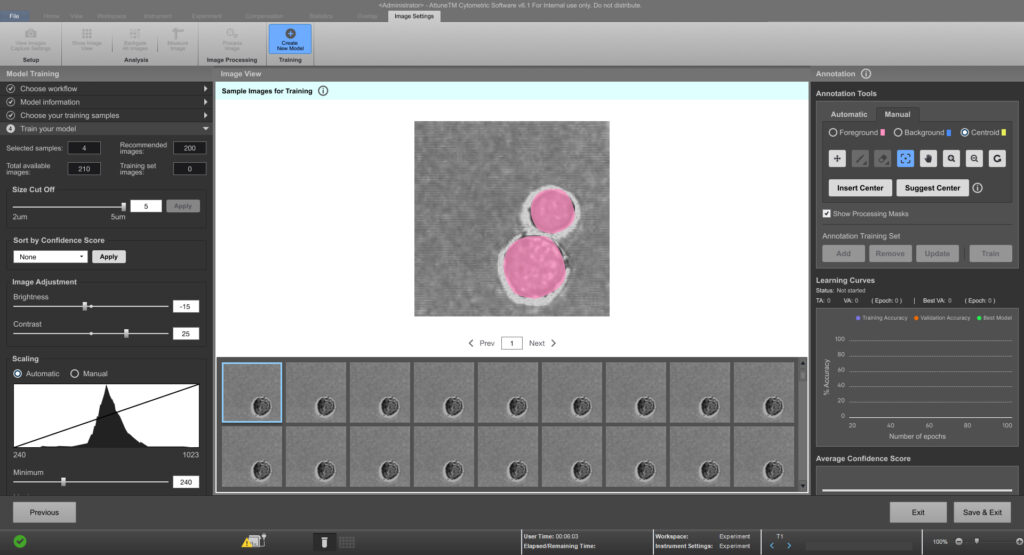
- Used manual and automatic centroid annotation tools (Insert/Suggest Center)
- Applied preprocessing controls (brightness, contrast, size filtering) for consistency
- Trained and evaluated models using built-in accuracy metrics and learning curves
Research & Insights
The Attune™ NxT workflow demonstrates a shift toward centroid-based annotation (“Hooke A”), enabling faster and simpler cell detection by focusing on cell centers rather than full segmentation. This reduces annotation time while maintaining reliable performance. The combination of user-guided and automated tools improves accuracy and consistency, while preprocessing controls ensure robustness across variable image conditions. By using optimized subsets of data and built-in performance metrics, the system supports rapid, scalable model development and makes AI-driven cytometric analysis more accessible.
What We Did
- User interviews with lab technicians and academic researchers
- Workflow walkthroughs of common ProQuantum tasks
- Heuristic evaluation against Komodo UX principles
- Collaboration with product managers and application scientists
- Collaboration with product managers and application scientists
- Users rely on step-by-step mental validation during assays
- Clear system feedback builds more trust than advanced visuals
- Progressive disclosure works better than information-dense dashboards
What We Did
- User interviews with lab technicians and academic researchers
- Workflow walkthroughs of common ProQuantum tasks
- Heuristic evaluation against Komodo UX principles
- Collaboration with product managers and application scientists
- Collaboration with product managers and application scientists
- Users rely on step-by-step mental validation during assays
- Clear system feedback builds more trust than advanced visuals
- Progressive disclosure works better than information-dense dashboards
- Consistency across steps reduces anxiety during high-stakes runs
What We Did
- User interviews with lab technicians and academic researchers
- Workflow walkthroughs of common ProQuantum tasks
- Heuristic evaluation against Komodo UX principles
- Collaboration with product managers and application scientists
- Collaboration with product managers and application scientists
- Users rely on step-by-step mental validation during assays
- Clear system feedback builds more trust than advanced visuals
The Breakthrough
The key breakthrough was the shift from complex, time-intensive segmentation to a fast and efficient centroid-based (“Hooke A”) detection approach. This significantly reduced annotation time while maintaining strong accuracy. By combining user input with AI-assisted suggestions, the workflow enabled reliable model training using smaller, optimized datasets. Ultimately, it empowered even non-expert users to build and deploy AI-driven analysis workflows with ease and consistency.
Our Process
Here is my Services. Where you will find my creativity and my working talents.
User Research
Conducted interviews & usability tests
Wireframing
Created new task flows & wireframes
UI Design
Built and modern, intuitive UI
UX Artifacts
Here is my Services. Where you will find my creativity and my working talents.